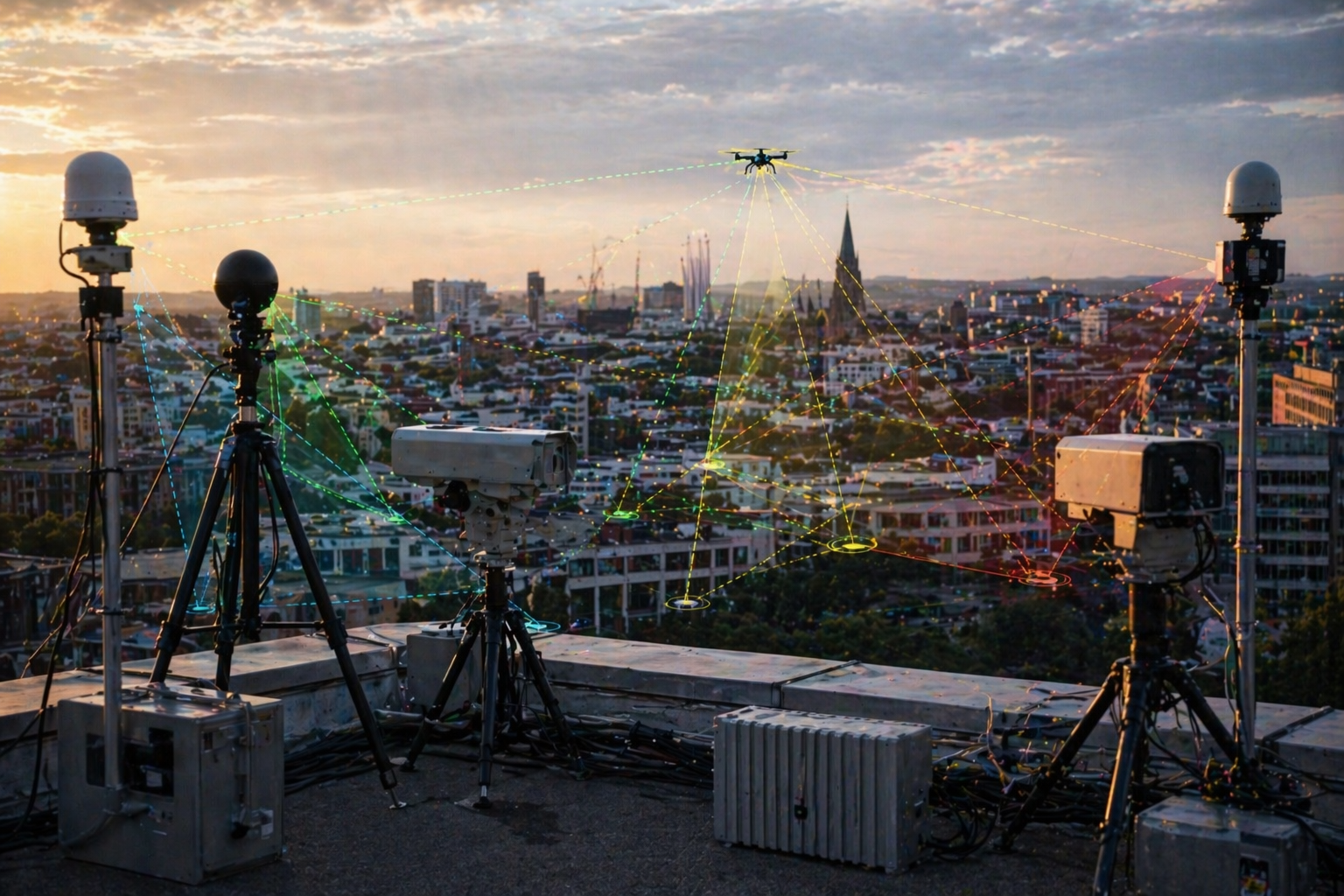
Putting sensors, trackers and effectors where they work
In the previous articles in this series, the focus has been on why Counter-UAS capability starts with planning, and how terrain, structures and environment shape the problem.
The next step is turning that understanding into practical deployment decisions. This is where many Counter-UAS approaches begin to break down.
Even where the environment and threat are understood, the placement of sensors, trackers and effectors is often driven by convenience, infrastructure or assumption rather than operational effectiveness. As a result, capability is introduced, but not always positioned in a way that delivers the intended outcome.
Effective Counter-UAS performance depends as much on siting as it does on the technology itself.
Siting is not a technical afterthought
It is easy to treat siting as a secondary consideration. Equipment is selected first, and placement is then determined by what is available, accessible or easiest to install. In practice, siting should be driven by the planning process, not constrained by it.
A sensor placed in a convenient location may still leave critical areas unobserved. A tracker positioned without consideration of overlap may struggle to maintain continuity. An effector deployed without understanding line of sight or engagement constraints may be ineffective at the point it is needed.
The result is not a lack of capability, but a mismatch between capability and requirement.
Detection alone is not enough
A common issue in Counter-UAS deployment is an over-reliance on detection.
Detection is only the first step. For a system to be effective, it must support recognition, identification, tracking and, where required, intervention. Each of these stages has its own spatial requirements.
A sensor may detect a drone at range, but if that detection cannot be maintained or developed into reliable tracking, its operational value is limited. Similarly, an effector may be capable in isolation, but without the right positioning and supporting coverage, it may not be usable when required.
Siting decisions need to consider the full chain, not just the first point of contact.
Overlap creates resilience
No single sensor or system provides complete coverage.
Effective Counter-UAS planning recognises this and builds in overlap. Overlapping coverage allows for continuity of tracking, reduces the impact of dead ground, and provides resilience if one element is degraded or unavailable.
This does not mean placing equipment everywhere. It means placing it deliberately, so that gaps are understood and mitigated where they matter most. Without overlap, coverage becomes fragile. Small gaps can become critical weaknesses.
Small changes have a big impact
One of the more overlooked aspects of siting is how sensitive it is to position.
A small change in elevation, orientation or location can significantly affect what can be seen and how effectively a system performs. A sensor placed a few metres higher, or shifted to a different structure, may gain or lose visibility over key areas.
Without proper analysis, these differences are easy to miss.
On paper, two locations may appear equivalent. In practice, one may provide effective coverage while the other introduces a gap that only becomes apparent once the system is in use. This is why siting should be tested and validated before deployment, not assumed.
Aligning capability to the problem
Effective siting starts with a clear understanding of what needs to be achieved.
Where does detection need to occur? Where does tracking need to be maintained? Where is intervention most likely to be required? Which areas carry the highest consequence if coverage is lost?
These questions link directly back to the environment and threat assessment. Siting decisions should be an extension of that analysis, not a separate activity.
When this alignment is in place, capability is positioned with intent. Sensors are placed where they can actually see. Tracking is maintained where it matters. Effectors are available where they are likely to be needed.
From placement to performance
Counter-UAS capability is often judged by the equipment used. In practice, performance is defined by how that equipment is deployed.
Well-sited systems can deliver effective coverage with fewer assets. Poorly sited systems can leave gaps even when significant capability is in place.
The difference is not the technology. It is the planning behind it.
In the next article in this series, the focus will move to layered defence and how coverage can be structured to build resilience rather than relying on single points of capability.
If you would like to explore the planning challenge further, we would be very happy to discuss the problem in more detail and, where useful, arrange a demo. Call +44 (0)1794 834750 or email enquiries@cunningrunning.co.uk. You can also follow Cunning Running Software Ltd on LinkedIn, or connect with Phil Cowell or John Overend.