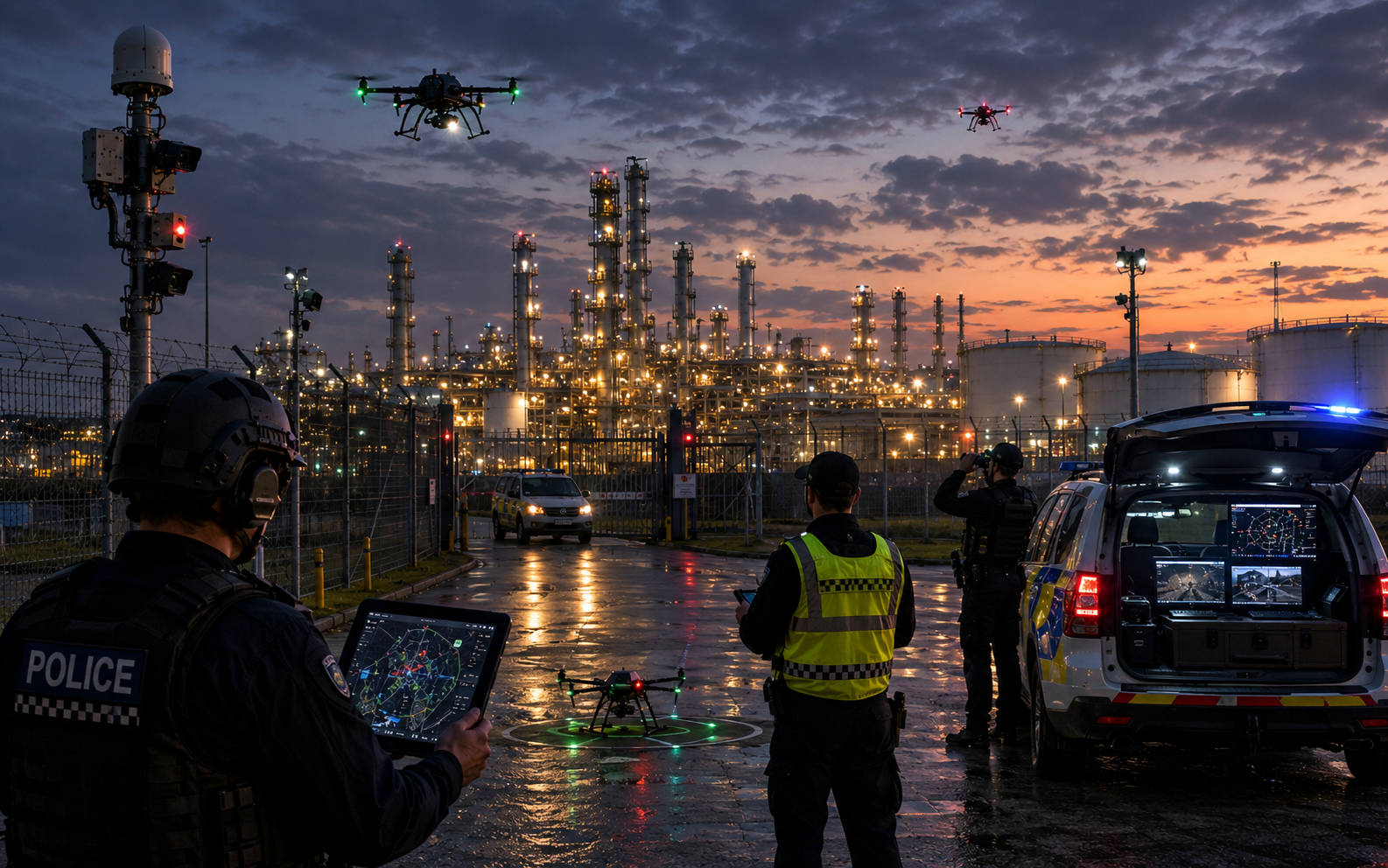
Across this series, the focus has been on Counter-UAS planning, understanding the environment, identifying vulnerabilities, siting capability effectively, and building layered resilience around the assets and activities that matter most.
This final article brings those themes together by looking at a wider operational challenge: how friendly UAS activity is planned and managed in an environment where hostile drone threats may also be present.
Counter-UAS planning is not just about stopping drones. In many operational settings, drones are also part of the legitimate response. Police, military, emergency services, security teams and infrastructure operators may all need to use UAS for observation, search, situational awareness, site assessment or operational support.
The challenge is therefore not simply, “How do we prevent drones from entering this area?”
It is also, “How do we safely manage the drones we need to operate?”
Not every drone is a threat
In a contested or complex environment, the presence of a drone does not automatically mean hostile activity.
A UAS may be supporting a police operation, inspecting infrastructure, assisting a search task, supporting event security or providing operational overwatch. At the same time, an unauthorised or hostile drone may also be operating within the same environment. That creates a difficult operating picture.
If friendly UAS activity is not planned and communicated properly, it can create confusion, increase false alarms and slow down operational decision-making. Legitimate activity may also be restricted or misinterpreted because it has not been properly deconflicted.
This is why friendly UAS planning needs to sit alongside Counter-UAS planning from the outset.
Deconfliction starts before the operation
Deconfliction is often treated as a procedural issue. In reality, it begins during planning.
Where will friendly drones launch from? Which routes will they use? What operating areas, timings and altitude bands are required? Where could friendly UAS activity conflict with detection zones, restricted areas or likely threat routes?
These questions need to be addressed before activity begins.
Without a clear plan, every drone can become a question mark. With a clear plan, operational teams have a stronger basis for understanding what should be in the air, what is authorised, and what requires further attention.
Planning routes, launch sites and operating areas
Friendly UAS operations should not simply be added into the environment once the Counter-UAS posture has been established. They need to be planned as part of the wider operational picture.
That means identifying suitable launch and recovery sites, safe operating routes, observation areas and potential conflict points. It also means understanding how friendly UAS activity may appear to sensors, control rooms, patrols and other operational users. The aim is to reduce unnecessary ambiguity during live operations.
A friendly drone route that passes through a sensitive detection area without coordination may create avoidable confusion. A launch site positioned close to a likely hostile launch location may complicate assessment. A poorly communicated operating window may trigger unnecessary escalation.
These are operational planning problems, not simply technical ones.
Counter-UAS and friendly UAS planning should inform each other
A good Counter-UAS assessment should help shape friendly UAS planning, and friendly UAS requirements should help shape the Counter-UAS posture.
Understanding likely hostile launch locations can help separate friendly launch points from areas of concern. Understanding dead ground and restricted visibility can help determine where friendly UAS may provide useful observation. Understanding protected assets and high-consequence areas can help define where friendly activity should be limited or carefully controlled.
Rather than treating Counter-UAS and friendly UAS as separate workstreams, they should be considered together as part of the same operational environment.
Both rely on understanding terrain, visibility, access, risk and consequence. Both require clear routes, defined operating areas and shared situational awareness.
Reducing uncertainty during live operations
During live operations, uncertainty slows decision-making.
If teams are unclear whether a drone is friendly, authorised, unauthorised or hostile, the operational picture becomes harder to manage. Information is checked repeatedly, decisions take longer, and confidence in the response can begin to degrade.
Planning cannot remove all uncertainty, but it can reduce it significantly.
Clear launch sites, operating routes, timings and coordination measures give teams a stronger baseline. They make it easier to identify activity that does not match the expected pattern and support quicker, more proportionate responses.
This becomes even more important in multi-agency environments where police, emergency services, security teams and infrastructure operators may all be operating together with different responsibilities and communications structures.
Without a shared understanding of the airspace and operational plan, confusion develops quickly.
From airspace awareness to operational clarity
The purpose of Counter-UAS and UAS planning is not simply to produce maps or coverage diagrams. The purpose is to create operational clarity.
Decision-makers need to understand where friendly activity is expected, where hostile activity is more likely, where coverage is strongest, and where vulnerabilities or uncertainties remain.
That understanding helps teams position capability more effectively, focus operational activity where it matters most, and respond more confidently when something does not fit the expected pattern.
Effective Counter-UAS and UAS planning is not simply about detecting drones. It is about understanding what should be in the air, what should not, and giving operational teams the clarity needed to make timely decisions in complex environments.
If you would like to explore the planning challenge further, we would be very happy to discuss the problem in more detail and, where useful, arrange a demo. Call +44 (0)1794 834750 or email enquiries@cunningrunning.co.uk. You can also follow Cunning Running Software Ltd on LinkedIn, or connect with Phil Cowell or John Overend.