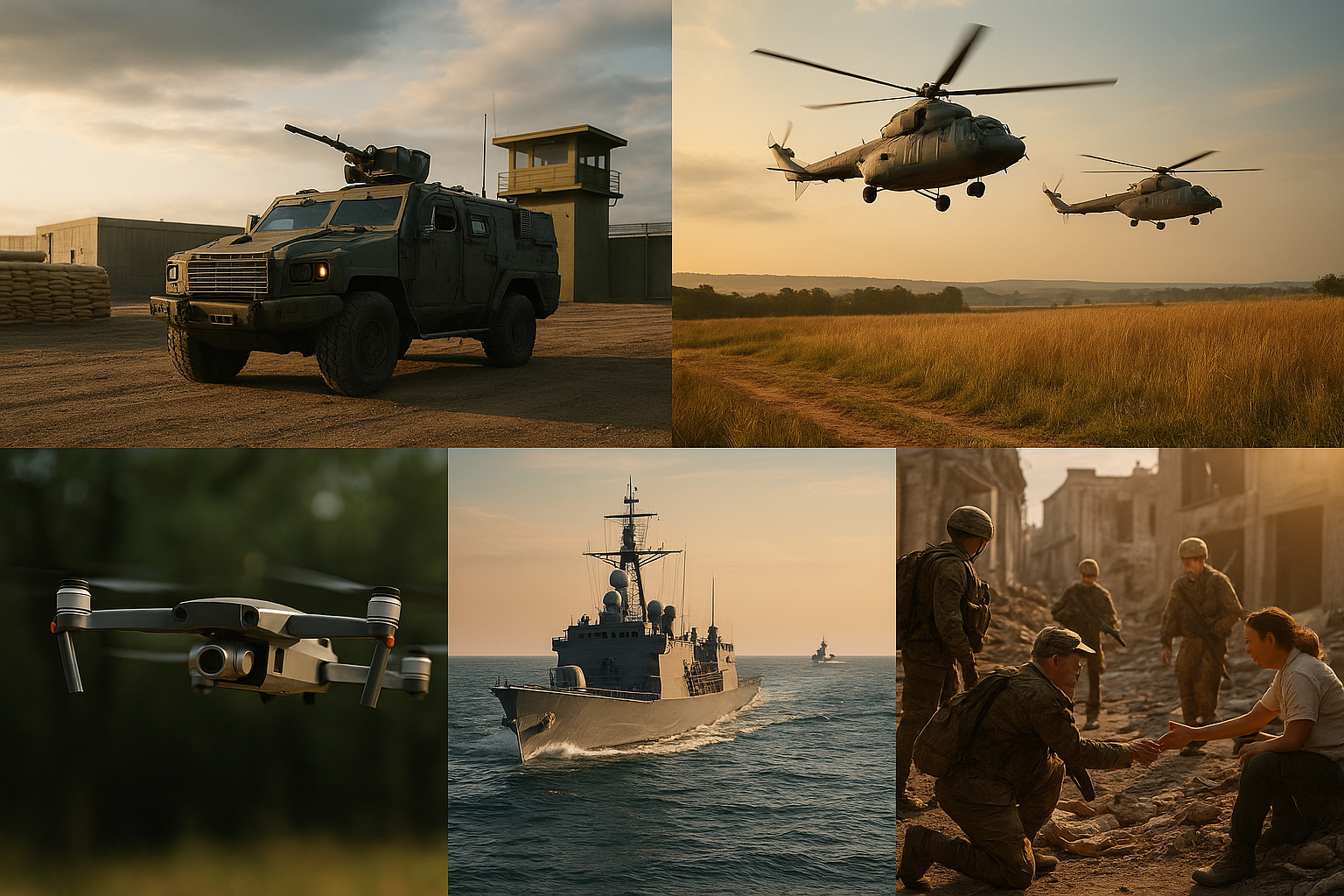
Every military operation, whether defensive or offensive, depends on preparation. Knowing where the threats are likely to come from, understanding the terrain, and planning protective measures before a mission begins can make the difference between success and failure. The Force Protection Planning Tool (FPPT) was created to give commanders this edge.
Origins and Purpose
FPPT was developed by Cunning Running Software Ltd, building on over 30 years of experience in geospatial threat analysis and defence planning. The company’s earlier tools, used by police and counter-terrorism agencies, proved that complex security assessments could be automated without losing accuracy. FPPT took that principle into the military domain, combining advanced mapping, line-of-sight modelling, and weapon data to produce fast, evidence-based, force protection plans.
Designed in close collaboration with serving personnel, FPPT reflects the realities of modern deployments. It enables planners to model direct-fire, indirect-fire, surface-to-air, and unmanned threats in minutes, providing a clear visual picture of vulnerabilities and options. It replaces subjective guesswork with measurable data, empowering users to make informed, defensible decisions.
Who Uses FPPT
FPPT is employed across the defence community:
- Army units use it for base defence, route security, and patrol planning.
- Air Force operators apply it to airfield and flightpath protection.
- Naval and Marine forces use it to plan littoral landings and protect ships operating near shore.
- Allied partners and NATO forces integrate it into joint exercises and interoperability studies.
The system is equally valuable for staff officers, engineers, and security specialists who need to brief commanders quickly and justify their recommendations with clear visual outputs.
How FPPT Works
At its core, FPPT converts digital terrain and surface data into an interactive operational map. Users can input specific weapon systems or threats, such as MANPADS, mortars, small arms, or sUAS, and the software calculates where those threats could be used effectively against a target. It factors in elevation, vegetation, built-up areas, and water features, producing an accurate “threat footprint” for any given scenario.
Once potential firing or launch points are identified, the user can assess and prioritise them within FPPT. The tool helps the user rank these positions by likelihood and develop corresponding patrol, surveillance, or countermeasure plans. FPPT enables this process quickly and consistently, but the decision-making always remains with the operator.
Why FPPT Matters
Traditional force protection planning is labour-intensive and often fragmented. Teams might rely on paper maps, local knowledge, or outdated imagery to assess vulnerabilities. In some cases, plans are still created using physical sandboxes, where rocks and sticks represent terrain features and enemy positions. FPPT transforms that process into a digital environment, preserving the same tactical creativity but adding precision, speed, and the ability to test multiple scenarios with real-world accuracy.
This delivers several operational advantages:
- Speed: Complex threat analyses that once took hours can now be produced in minutes.
- Accuracy: The software uses detailed terrain data to model realistic lines of sight and engagement angles.
- Consistency: Standardised outputs reduce human error and ensure all units work from the same information.
- Adaptability: Scenarios can be saved, modified, and re-run as the situation evolves, supporting both pre-deployment planning and in-theatre updates.
Built for Real-World Operations
FPPT is not a theoretical tool. It has been tested and refined through feedback from military users who use it daily. Whether planning the defence of a forward operating base, identifying secure helicopter landing zones for CASEVAC, or assessing threats to a harbour approach, the tool delivers practical insight that commanders can act on immediately.
Because it is fully hardware-agnostic, FPPT integrates with existing mapping systems and exports data to Esri, MapInfo, Google, and ATAK formats. Reports can be generated as Word or PDF documents, complete with images, notes, and map overlays ready for inclusion in briefings. This ensures that information flows smoothly between planning staff and frontline units.
Evolving to Meet New Threats
The operational environment is changing rapidly. The growing use of drones, the persistence of stand-off weapons, and the increasing overlap between kinetic and electronic threats all demand faster, smarter planning tools. FPPT continues to evolve to meet those needs, adding new modules for counter-UAS assessment, sensor placement optimisation, and search management.
Each of these capabilities will be explored in upcoming articles in this series, covering:
- Aviation security and airfield protection
- Army base defence and forward operations
- Maritime and littoral force protection
- Humanitarian and disaster-relief planning
- The rising threat of small unmanned aerial systems
Conclusion
FPPT gives today’s armed forces the ability to anticipate threats rather than react to them. It unites accurate data, proven methodology, and operational practicality into one planning environment. By understanding where attacks could originate and how to counter them, commanders can protect personnel, equipment, and mission outcomes more effectively.
Force protection is about foresight, not fortune. FPPT provides that foresight quickly, clearly, and with the precision demanded by modern military operations.
If you would like to explore this further, we would be very happy to arrange a demo. Just call us on +44 (0)1794 834750 or email enquiries@cunningrunning.co.uk.
Alternatively, connect with us on LinkedIn and follow the Cunning Running company page, or the LinkedIn pages of Phil Cowell or John Overend.