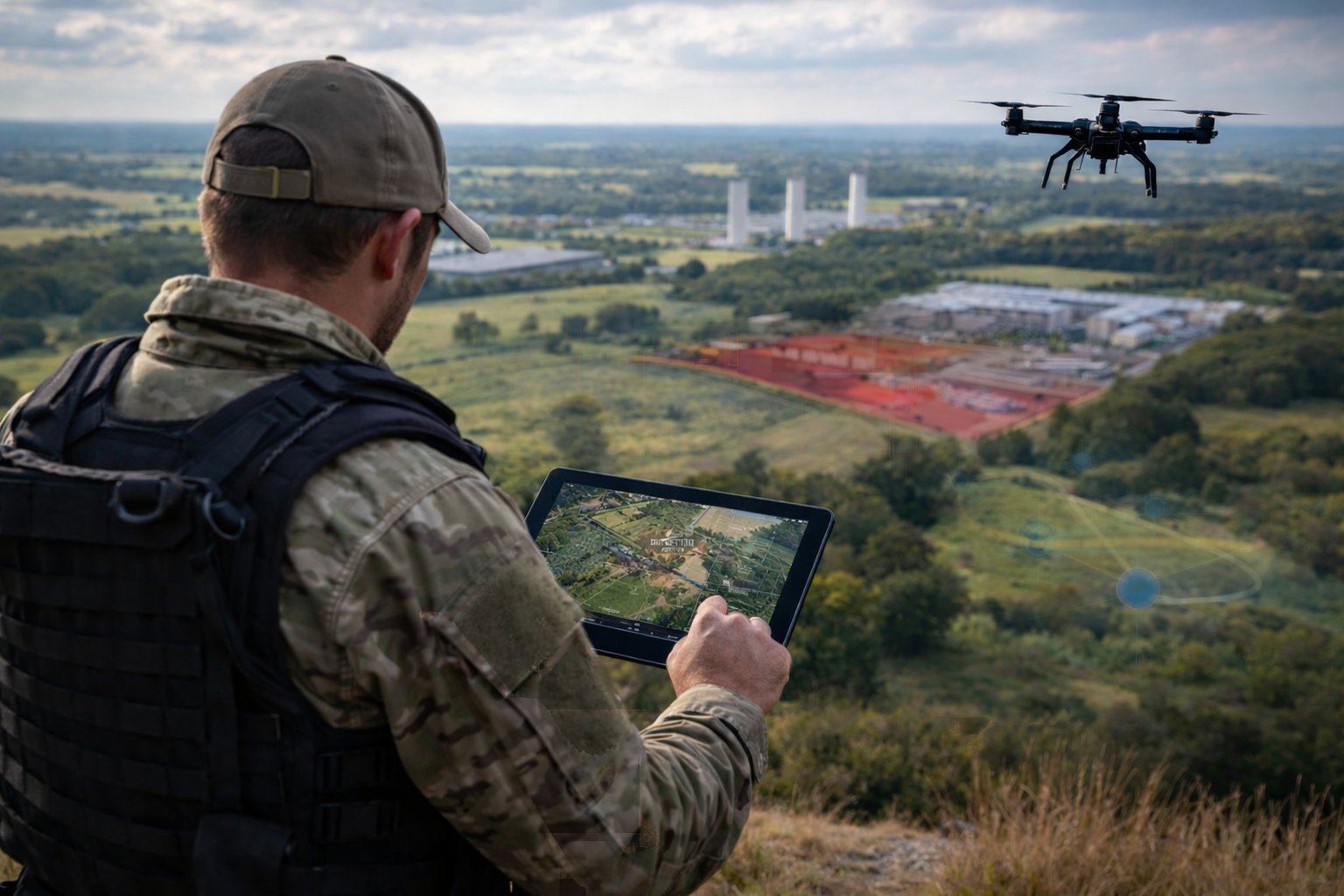
In this new series of blogs, the focus will be on Counter-UAS and UAS planning, specifically the crucial roles that spatial analysis and informed planning play in building effective Counter-UAS assessments and deployments.
Across policing, defence, security and critical national infrastructure, the drone threat is now well understood. What is less consistent is the quality of the planning that sits behind the response. Too often, organisations move quickly to discussions about sensors, trackers and effectors before they have properly defined the environment, the likely threat routes, the vulnerabilities that matter most, or the operational outcome they are trying to achieve.
These strategic omissions are what this series will address.
Over the coming articles, the themes will include terrain, dead ground, likely drone approach routes, sensor siting, layered coverage, vulnerability-led planning, and the challenge of balancing hostile drone threats with friendly UAS operations. The aim is not simply to discuss technology, but to look at how better planning leads to better operational decisions.
Effective Counter-UAS capability does not begin with hardware. It begins with planning.
It is easy to assume that progress starts when a sensor is bought, a tracker is positioned, or an effector is selected. Those decisions should come later. Before any deployment takes place, the site, the threat, the terrain and the operational requirement all need to be understood. Without that, even capable technology can be placed in the wrong location, pointed at the wrong problem, or expected to perform in conditions that limit its value.
This is where many Counter-UAS programmes begin to drift. The discussion moves quickly to product specifications, coverage claims and equipment choices, while more important questions remain unanswered. What is actually being protected? From which directions is the threat most likely to come? Where are the blind spots? How does the terrain affect lines of sight, masking and approach routes? How might a hostile operator exploit the environment?
These factors are planning questions, and they come first.
Every environment shapes the drone threat differently. A dense urban site creates a very different planning problem from an open rural location. Critical infrastructure, public venues, transport hubs, secure compounds and temporary deployments all bring their own vulnerabilities, access considerations and operational constraints. Buildings, vegetation, topography and surrounding infrastructure all affect what can be seen, what can be tracked, and where equipment will or will not perform effectively.
Good Counter-UAS planning starts by understanding the environment in the round.
That means looking beyond the protected asset itself and assessing the surrounding area as a whole. Likely launch points, concealed operator locations, dead ground, observation opportunities, elevated terrain and standoff positions all matter. A sensor may appear impressive on paper, but if it is masked by terrain or placed where clutter degrades performance, its nominal capability becomes far less relevant.
The same principle applies to trackers and effectors. Detection alone is not enough if recognition, identification, tracking and response are not supported by sensible siting and overlap. Poor planning can leave an organisation with fragmented coverage, false confidence and gaps in the very areas that matter most.
Threat behaviour also must be considered early.
Hostile drone activity is not random. Operators will often use terrain, structures, clutter and local activity patterns to reduce visibility and improve their chances of success. They will look for routes that minimise exposure and maximise access to the target area. Any Counter-UAS posture that ignores likely operator behaviour is incomplete, regardless of how capable the equipment may appear.
This is why planning should be built around vulnerability and consequence, not just geography. Not every part of a site is of equal importance. Not every direction presents the same level of threat. Some areas require persistent coverage, while others are of lower priority. Some assets demand early warning, while others require stronger tracking or response options. Good planning distinguishes between them and allocates capability accordingly.
This leads to a more practical and defensible approach. Rather than asking, ‘What equipment should be bought?’, the correct starting point is, ‘What problem needs to be solved, in this environment, against this type of threat?’ Once that is clear, decisions about sensors, trackers and effectors become more grounded. Siting becomes more purposeful, coverage assumptions become more realistic, and investment is easier to justify because it is tied directly to the operational requirement.
In practice, effective Counter-UAS planning should answer a small number of critical questions before deployment begins:
- What exactly is being protected, and what would a successful drone incursion look like?
- Which routes, positions and terrain features are most likely to be exploited by a hostile operator?
- Where are the areas of dead ground, masking and restricted visibility?
- Where does detection need to happen, and where does tracking or intervention need to be strongest?
- How can coverage be layered so that resilience is built in rather than assumed?
These are not secondary considerations. They are the foundation of an effective deployment.
Counter-UAS capability is strongest when shaped by the environment, the threat and the mission. Technology still matters, but sensors, trackers and effectors are only as effective as the planning behind them.
That is why Counter-UAS planning starts before the first sensor is deployed.
In the next article in this series, the focus will shift to terrain, dead ground and likely drone threat routes, and why understanding the physical environment is one of the most important parts of building an effective Counter-UAS posture.
If you would like to explore the planning challenge further, we would be very happy to discuss the problem in more detail and, where useful, arrange a demo. Call +44 (0)1794 834750 or email enquiries@cunningrunning.co.uk. You can also follow Cunning Running Software Ltd on LinkedIn, or connect with Phil Cowell or John Overend.